
Private Northern Lights Tours in Lapland: When, Where & How We Plan Them
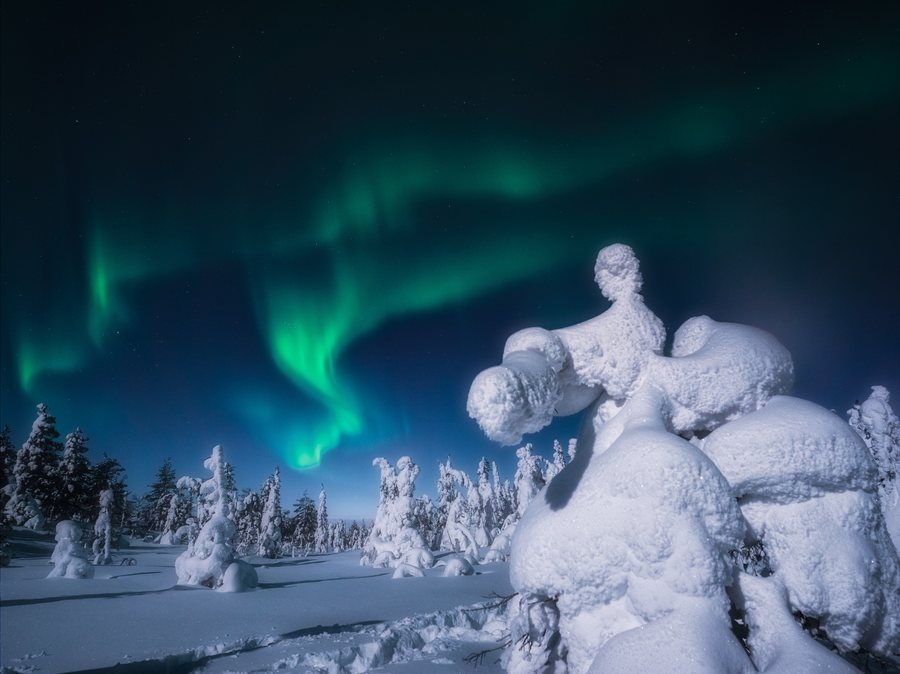
Most Northern Lights trips are built around a single hope: that the sky cooperates on the one night you've booked a tour. A private evening works differently. Rather than a fixed excursion at a fixed hour, it's a plan that moves with the forecast — built around where the clouds are thinnest and the geomagnetic activity is strongest, on whichever night gives you the best odds.
Below is how we actually plan them: the season, the locations, and the honest limits of what can be promised when the display in question is a natural phenomenon rather than a scheduled show.
What Makes a Northern Lights Evening Private
A private aurora evening means no shared minibus, no fixed departure time, and no itinerary set weeks in advance without regard for the sky. Instead, your guide checks the forecast — cloud cover, geomagnetic (Kp) activity, and moon phase — on the day itself, and chooses the location and timing accordingly. If conditions look better two hours' drive north, that's where you go. If the display is likely to peak after midnight, your evening is built around that.
It also means the pace is yours. Some guests want warm drinks and a fire while they wait; others want to be moving between viewpoints all night. Both are the same evening, arranged differently.
Best Time to See the Northern Lights in Lapland
The aurora season in Finnish Lapland runs from late August through early April, whenever the sky is dark enough for the lights to be visible — which rules out the near-endless daylight of Lapland's summer. Within that window:
- September & October — long nights return, and the aurora is often visible against a still-snowless landscape, reflected in lakes rather than snow.
- November — reliably dark, though cloud cover is more common than midwinter.
- December to February — the longest nights of the year and, in our experience, the most consistent viewing window, paired with full snow cover for glass igloo and wilderness stays.
- March — often the clearest skies of the season, thanks to more stable high-pressure weather, still with dark enough nights.
There is no single “best” month so much as a best combination of clear skies and geomagnetic activity on a given night — which is precisely why we plan around the forecast rather than the calendar.
Where We Take You
Visibility comes down to two things: darkness and unobstructed sky. We move away from the light pollution of towns entirely, toward locations chosen for their horizon and their odds on a given night, rooted around Rovaniemi and reaching further into Saariselkä, Levi, and Pyhä — and, for guests seeking further discretion, rarer destinations such as Kuusamo and Kilpisjärvi, one of the darkest skies in Finland.
Elevated, open terrain — frozen lakes, fell tops, forest clearings — tends to outperform anywhere with a treeline blocking the northern horizon, so your guide will often choose a specific hilltop or lakeshore over a “scenic” but enclosed location.
How We Plan Around the Forecast
Every evening starts with the same two questions: how clear will the sky be, and how active is the geomagnetic field. Your guide tracks both throughout the day and adjusts departure time, direction, and duration accordingly — sometimes that means a late departure after 11pm, sometimes it means moving locations mid-evening if clouds roll in from one direction.
What we won't do is promise a sighting. No operator honestly can — the aurora is a natural phenomenon, not a performance. What we control is everything within reach of that: local knowledge, real-time forecasting, and the flexibility to try again the following night if your itinerary allows for it.
Pairing It With the Rest of Your Stay
A private Northern Lights evening rarely stands alone. Many guests pair it with a night in a glass igloo, falling asleep beneath the aurora with the option to wake for a second window without stepping outside, or with a snowmobile safari earlier in the trip to scout terrain by daylight. We build all of it — accommodation, guides, timing — into one itinerary rather than a series of separate bookings.
Frequently Asked Questions
What is the best time to see the Northern Lights in Lapland?
The aurora season runs from late August to early April, with the longest, darkest nights — and typically the clearest odds — between December and March. We watch geomagnetic and cloud-cover forecasts continuously rather than committing to one “best” month, since a clear, quiet night in November can outperform a cloudy one in January.
How many nights should we stay to see the Northern Lights?
We recommend a minimum of three to four nights in Lapland. The aurora depends on clear skies and geomagnetic activity, both of which vary night to night, so more nights simply means more chances — and more room for us to move you to a better location if the forecast shifts.
What happens if the Northern Lights don't appear during our stay?
No operator can guarantee a natural phenomenon, and we won't pretend otherwise. What we can guarantee is that every evening is planned around the most current forecast, led by guides who know exactly where the sky is likely to open, with a private itinerary flexible enough to try again the following night.
Can a private Northern Lights evening be combined with a glass igloo stay?
Yes — it's one of our most requested combinations. Falling asleep beneath a glass ceiling after a private aurora expedition, with the option to wake for a second viewing window without leaving your bed. We arrange this as part of a wider itinerary alongside villas, luxury hotels, and wilderness experiences.